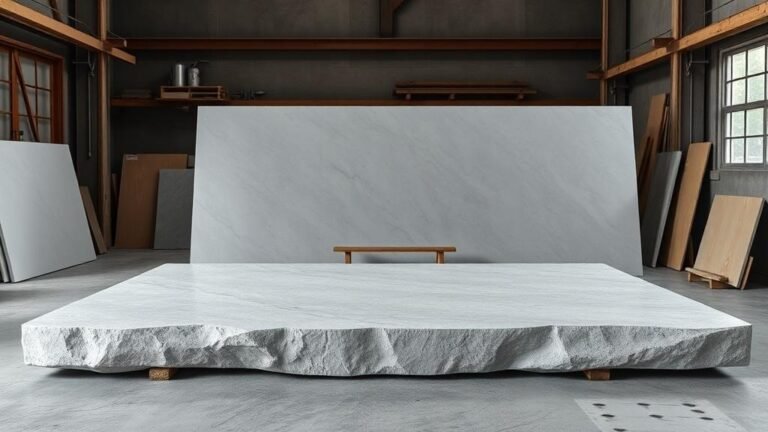
For stoneworks industry, the useful answer lives in the shop floor details: slab photos, measurements, install constraints, and whether the team can trust the number before anyone starts fabricating stone.
Last October I walked through a shop outside Grand Rapids that had been open for eight months. The owner, a former GC named Derek, had two CNC machines (one still wrapped in shipping plastic), a bridge saw from 2019 he’d bought secondhand, and exactly three employees. He was doing about $85,000 a month in residential tops. Not bad. But when I asked about his silica compliance program he pointed at a box fan duct-taped to a window frame and said, “We wet-cut everything, so we’re fine.” He wasn’t fine. And the gap between what Derek thought the trade looked like and what it actually demands is exactly the gap that kills new shops in years two and three.
The stoneworks industry in the U.S. is roughly 4,800 active fabrication shops producing an estimated 2.1 million residential kitchen tops per year. That number sounds large until you realize how thin the labor pool is, how concentrated the slab supply chain remains, and how much OSHA’s silica enforcement has changed the capital requirements of running even a modest operation. This isn’t a trade you can stumble into anymore with a used saw and a pickup truck. Well, you can. But you probably won’t survive.
The Labor Problem Nobody Has Solved
Labor is the constraint that binds everything else. Not material costs, not equipment depreciation, not even regulatory compliance. Labor.
Templator roles in metro markets run $58,000 to $92,000 a year with full benefits. CNC operators pull $52,000 to $84,000 depending on experience and the complexity of the machines they’re running. Those numbers have climbed steadily since 2020, and the talent pool hasn’t grown to match. Shops with disciplined hiring practices (actual job postings, structured interviews, competitive benefits packages) still take 6 to 14 weeks to fill an open templator slot. Shops without those practices? Five to nine months, according to trade reporting. Some never fill the role at all.
The boring truth is that most shop owners underestimate what it takes to attract and keep skilled fabrication labor in 2026. They benchmark against what they paid people five years ago, or against what a general laborer earns in their county, and then wonder why nobody applies. A good templator with digital experience is not a general laborer. Treating the role that way is the fastest path to a permanently understaffed shop.
See also: SEO and Machine Learning: How Artificial Intelligence is Shaping Search Optimization
Where the Stone Actually Comes From
Roughly 78 percent of natural stone volume in the U.S. is imported. Brazil, India, Turkey, and Italy are the dominant origin countries, each with different strengths (Brazilian granite and quartzite, Indian granite, Turkish marble, Italian marble and travertine). On the engineered side, the market is dominated by Cambria, Silestone, MSI Q, Caesarstone, and Cosentino’s Dekton and Silestone lines.
Understanding slab supply chains isn’t academic. It’s directly connected to margin. Shops with disciplined material knowledge, meaning they understand origin pricing, container logistics, distributor markup structures, and brand-tier positioning, negotiate up to 8 percent better slab pricing than shops buying blind from whoever’s closest. On a mid-sized shop doing $3 million in revenue, 8 percent on materials is real money. That’s the difference between a healthy year and a tight one.
The engineered quartz segment continues to grow market share against natural stone, which reshapes both the supply conversation and the fabrication workflow. Engineered slabs cut differently, profile differently, and generate different dust hazards (more on that below). Owners who treat quartz and natural stone as interchangeable in their shop processes are asking for trouble.
Silica Compliance Is a Capital Decision
OSHA 29 CFR 1926.1153 sets the permissible exposure limit for respirable crystalline silica at 50 micrograms per cubic meter over an 8-hour time-weighted average. That standard has been in force since 2017, and enforcement has only gotten more aggressive.
Here’s what that means in practice: cutting, grinding, profiling, and polishing stone all produce respirable silica particles. Wet-cutting on bridge saws, CNC routers, and waterjets is the primary engineering control. Local exhaust ventilation on dry operations (hand polishing, finish work, seam prep) is the second line. Half-mask respirators with P100 filters cover residual risk where engineering controls can’t eliminate exposure entirely. And most trade-active shops in 2026 run quarterly air sampling on representative tasks, keeping records on file for inspections.
None of this is optional. And none of it is cheap. A proper wet-cutting setup, ventilation system, air monitoring program, and respiratory protection inventory represents significant capital outlay. For Derek outside Grand Rapids, getting from a box fan to actual compliance was going to cost him somewhere north of $40,000, not counting the downtime during installation. He didn’t know that when he opened. Most new owners don’t.
My honest take: silica compliance is now a barrier to entry in this trade, and that’s probably a good thing. The shops that can’t or won’t invest in proper dust control shouldn’t be operating. The workers in those shops are the ones who pay the price.
What a Mid-Sized Shop Actually Looks Like
The typical mid-sized stone fabrication shop in 2026 runs 8 to 22 employees and generates between $1.6 million and $5.4 million in annual revenue. Shops in growth markets (think Raleigh, Boise, the I-4 corridor in Florida) tend to push toward the higher end of revenue per employee, closer to $260,000, and net margins closer to 22 percent. Shops in mature, competitive markets run lower on both metrics.
Technology adoption varies wildly across this mid-market segment. The shift from hand templating to digital templating, from manual bridge saws to CNC fabrication, and from spreadsheets to integrated vertical software platforms has been underway for a decade, but plenty of shops are still running some combination of old and new. (I’ve seen shops with a $350,000 CNC router and a scheduling system built in a spiral notebook.)
Consolidation pressure from multi-location operators continues to shape the competitive landscape. Larger operators have advantages in purchasing, labor recruitment, and platform investment. Single-location shops aren’t disappearing, but the ones that survive tend to be the ones running disciplined operations across all five domains: market awareness, supply chain, labor, regulatory compliance, and technology.
For the full operational reference on how these domains fit together, https://https://slabwise.com/guides/stoneworks-industry covers the stoneworks industry knowledge workflow end to end.
The Compounding Effect of Actually Knowing Your Trade
Running a stone shop is a bit like playing chess against five opponents simultaneously: slab pricing, labor markets, OSHA compliance, technology decisions, and competitive positioning all move on their own timelines, and the interactions between them are where the real complexity lives. A tariff change on Brazilian granite affects your material cost, which affects your pricing, which affects your competitive position, which affects whether you can afford to offer the wages that attract the templator you need. It’s all connected.
Owners who build disciplined industry knowledge, and I mean a working reference they actually consult, not a binder gathering dust on a shelf, tend to see the compounding pay off over a 5 to 10 year horizon. They fill roles faster. They negotiate better on materials. They don’t get blindsided by regulatory changes. They make better calls on equipment purchases and (critically) on when not to expand.
Three trade organizations offer member resources and peer networks worth the dues: the Natural Stone Institute, the International Surface Fabricators Association, and the Marble Institute of America. The peer benchmarking discussions at regional meetings are, in my experience, worth more than any consultant report. Nothing recalibrates your assumptions like sitting across from someone running the same size shop in a comparable market and hearing their actual numbers.
Owners benchmarking against trade peers should weight their regional context heavily. A shop in Phoenix and a shop in Pittsburgh are playing different games even if they run identical equipment. Published ranges are useful directional tools, not scorecards.
The operational lift from undertrained to disciplined practice is real, typically a 12 to 18 month rollout if you’re serious about it. But the shops that make it through that process are the ones still operating a decade later.
Frequently Asked Questions
Q: Is the stone trade growing or contracting in 2026? A: Residential remodeling volume in 2026 remains close to 2023-2024 levels. Engineered quartz continues to grow market share against natural stone, so the mix is shifting even as total volume holds relatively steady.
Q: What is the labor outlook in the stone trade? A: Labor remains the binding constraint. Templator and CNC operator roles are especially hard to staff, and compensation expectations have risen significantly since 2020.
Q: What pay do templators earn in metro markets? A: Templator pay in metro markets ranges from $58,000 to $92,000 with full benefits in 2026, depending on experience, digital templating proficiency, and local market competition.
Q: How has OSHA silica enforcement affected the trade? A: OSHA 29 CFR 1926.1153 silica enforcement has driven significant capital investment in wet-cutting, ventilation, air monitoring, and respiratory protection programs since 2017. Shops without disciplined silica practice face real enforcement risk.
Q: How many stone fabrication shops are there in the United States? A: Trade estimates put the U.S. shop count at roughly 4,800 active fabrication shops in 2026, with residential volume dominating.
Q: What does a mid-sized fabrication shop look like financially? A: Mid-sized shops typically run 8 to 22 employees with annual revenue between $1.6 million and $5.4 million. Revenue per employee and net margin vary significantly by regional market conditions.
Q: Where do most slabs come from? A: Roughly 78 percent of natural stone volume is imported, primarily from Brazil, India, Turkey, and Italy. Engineered quartz is dominated by brands including Cambria, Silestone, MSI Q, Caesarstone, and Cosentino.
Stone fabrication generates respirable crystalline silica dust. Shops must follow OSHA 29 CFR 1926.1153 standards (50 ug/m3 PEL over 8-hour shift). Wet-cutting methods, ventilation, and respiratory protection are not optional.